


For foreign software engineers building a career in Tokyo, the Employees' Pension Insurance (Kosei Nenkin) is often viewed as a permanent, unrecoverable deduction from their monthly invoice or salary.
If you plan to remain in Japan for decades, this infrastructure secures your retirement.
However, if your engineering timeline involves a 2- to 5-year sprint in Tokyo before relocating back to Europe, the US, or other parts of Asia, these forced monthly contributions can feel like a massive financial drain.
Fortunately, Japan's social security framework provides a structural mechanism to reclaim a massive portion of this capital when you leave: the Lump-Sum Withdrawal Payment (Dattai Ichijikin).
This guide provides a comprehensive breakdown of the precise financial engineering strategies and technical protocols required to legally extract and maximize your Kosei Nenkin asset recovery upon departure.
【Quick Access】
Want to instantly map out " your current true net take-home pay " and evaluate the real efficiency of your overtime earnings as an employee?
Decoupling Your Tech Career from Japan’s Social Security System
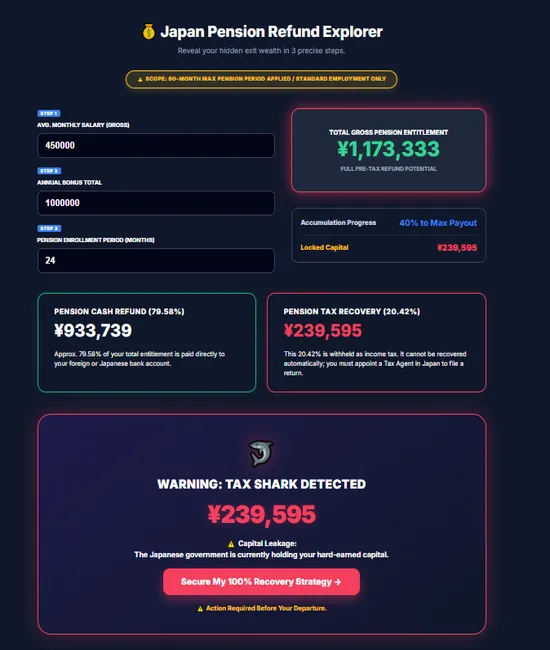
For short-term international engineers, Japan's pension framework can act as a structural bottleneck that temporarily freezes your capital. Before diving into the deep optimization mechanics, you should baseline your expectations. By analyzing your average monthly salary, bonus payouts, and total months of coverage, you can project your potential recovery asset pool.
[Estimate Your Recovery]
Run a baseline simulation of " your projected lump-sum pension payout " instantly:
The Lump-Sum Withdrawal Payment is an institutional fallback mechanism designed specifically for non-Japanese citizens who have contributed to the national pension framework for a minimum of six months but choose to permanently exit the country before fulfilling the minimum 10-year residency vesting period required to claim a lifelong monthly retirement annuity.
For high-income technical professionals, navigating this recovery process requires moving away from casual blog advice and executing a precise, step-by-step financial engineering plan. Mismanaging the technical execution of your exit timeline, banking configurations, or tax representation will result in thousands of dollars in permanently lost liquidity.
The Hidden Arbitrage: Maximizing Your Pension Recovery Window
Many relocating software engineers treat the pension refund as a minor, administrative afterthought. This is a severe financial error. For a mid-level to senior developer earning between ¥8,000,000 and ¥14,000,000 in Tokyo, the accumulated pension assets over a 3- to 5-year tenure represent a highly substantial liquidity pool. The core strategy is to treat this recovery not as a simple bureaucratic form, but as a deliberate capital arbitrage play.
First, you must understand the structural expansion of the recovery ceiling. Following major structural policy reforms, the statutory refund ceiling was officially expanded to 60 months (5 years). This policy pivot completely rewrites the financial calculus for international engineers moving to Tokyo. Under the old 36-month cap, staying in a Japanese tech role for a fourth or fifth year incurred a steep, unrecoverable tax penalty on your global net worth. Under the current 60-month framework, you can structurally extend your high-yield Tokyo engineering sprint to a full 5-year cycle, maximizing your local savings rate while ensuring that every single month of your retirement deductions remains fully retrievable at the back end.
To successfully execute this arbitrage, your operational timeline must be meticulously optimized against the Japan Pension Service's underlying mathematical formula. The final lump-sum payment is calculated using your Average Standard Remuneration (Heijun Hoshu Getsugaku). The critical nuance that most engineers miss is that your "Standard Remuneration" includes not only your base monthly salary, but also the gross amount of your seasonal corporate performance bonuses. If you exit the country immediately after a major bonus payout but before those earnings are structurally balanced across your rolling career average, you can inadvertently shift your calculation bracket.
The Trust Boundary: Designing Your Tax Representation Architecture
The ultimate point of failure for most engineers navigating the pension refund process is the hidden structural friction built into the payout mechanism itself: the automatic 20.42% income tax withholding. When the Japan Pension Service officially approves your application and transfers your Kosei Nenkin refund into your designated overseas bank account, they instantly slice away 20.42% of your total recovered asset base and surrender it to the Japanese National Tax Agency as a flat withholding tax.
To reclaim this missing fifth of your capital, you must implement a strict financial evacuation protocol by appointing a Tax Representative (Nozei Kanreinin) before your departure. This step is not merely an administrative checkbox; it is the establishment of a critical security perimeter over your capital. Your representative does not need to be a certified accountant, but they must be an individual residing in Japan with an active domestic bank account who will receive your physical original Notice of Payment (Dattai Ichijikin Kansutei Tsuchisho) via international mail and file a retrospective tax return (Kakutei Shinkoku) on your behalf.
When designing this architecture, you must evaluate three distinct trust profiles, balancing cost against operational risk:
The Expat Peer (Low Cost / High Operational Risk): Appointing a fellow foreign engineer who remains in Tokyo. While logistically convenient and zero-cost, this creates a single point of failure if your peer suddenly decides to relocate out of Japan before your 6-to-12-month processing window concludes, instantly freezing your access to the tax office.
The Local Japanese Contact (Moderate Cost / Moderate Operational Risk): Utilizing a trusted local friend or former colleague. This provides baseline stability since they are entrenched in the domestic system. However, standard Japanese individuals rarely possess experience dealing with non-resident retroactive withholding tax claims, often leading to formatting friction at the tax office.
The Professional Licensed Agent (High Cost / Zero Operational Risk): Contracting a specialized Japanese tax scrivener (Zeirishijo). While they extract an upfront or percentage-based fee, they execute the filing over an optimized, repeatable pipeline, ensuring your remaining 20.42% is recovered without administrative rejections.
Clock Cycle Optimization: Resignation and Municipal De-registration
To maximize the extraction value of your pension capital, you must treat your exit calendar like a real-time system optimization problem. The core variables you must manipulate are the timing of your final corporate bonus payout, the formal date of your corporate offboarding, and the exact clock cycle of your municipal move-out processing (Tenshutsu Todoke).
The optimal execution sequence involves aligning your resignation so that your final, high-value performance bonus is fully processed and paid into your account prior to your official loss of employment status. Because the Japan Pension Service samples your entire historical contribution window to establish your Average Standard Remuneration, landing a large bonus right at the end of your tenure structurally elevates the mathematical baseline used for your refund calculation.
Simultaneously, you must coordinate this with your local ward office (Kuyakusho). You must execute your municipal move-out processing to take effect exactly on or immediately after your final official day of employment, but prior to your international flight. If you submit your pension claim while your name remains active on a local municipal register, the system will flag you as an active resident and issue an immediate rejection. However, if you move out too early while your employer is still actively running payroll cycles, you can cause a mismatch in your social insurance status. The entire sequence must be executed within a tight, optimized 14-day window.
Hedging the Back-End: Mitigating Cross-Border Currency Volatility
The final, often ignored vulnerability in the pension extraction pipeline is the exposure to cross-border currency risk. The Japan Pension Service calculates your baseline assets strictly in Japanese Yen (JPY), but they will execute your primary 79.58% net payout in the local fiat currency of your designated destination bank account (e.g., USD, EUR, or GBP).
Because the central processing window for a standard application spans anywhere from 6 to 12 months from your date of submission, you are structurally exposed to macro-economic currency fluctuations over a multi-month period. If the Japanese Yen experiences heavy depreciation against your target currency during this administrative waiting block, the purchasing power of your final payout can shrink significantly by the time it clears international routing.
To hedge against this back-end volatility, you must decouple your banking destination from rigid legacy institutions. Specify a cross-border banking engine or multi-currency account infrastructure that allows you to receive the funds natively or lock conversion spreads.
Furthermore, ensure your Tax Representative utilizes a high-efficiency transfer system like Wise when moving the final 20.42% tax refund across the border. Standard Japanese retail banks charge excessive outward remittance fees and apply un-optimized retail exchange rates, which can shave off hundreds of dollars from your final recovered capital. By controlling the conversion mechanics, you finalize your Japanese tech sprint with maximum capital efficiency.
Ready to model your exit strategy? By inputting your precise historical or current salary progression, actual corporate bonus allocations, and projected months of residency in Japan, you can map out exactly how much liquid cash you can legally extract from the national treasury.
[Execute Simulation]
Run " your precision calculations " now:
About the author
- Ex-Automotive OBD Engineer from a JTC. 🛠️ Helping foreign devs bridge the workplace gap via cultural hacks & technical Japanese. See japan-refactor.com for JTC survival logic. 🚀
Comments
Join the discussionNo comments yet. Be the first to comment.
